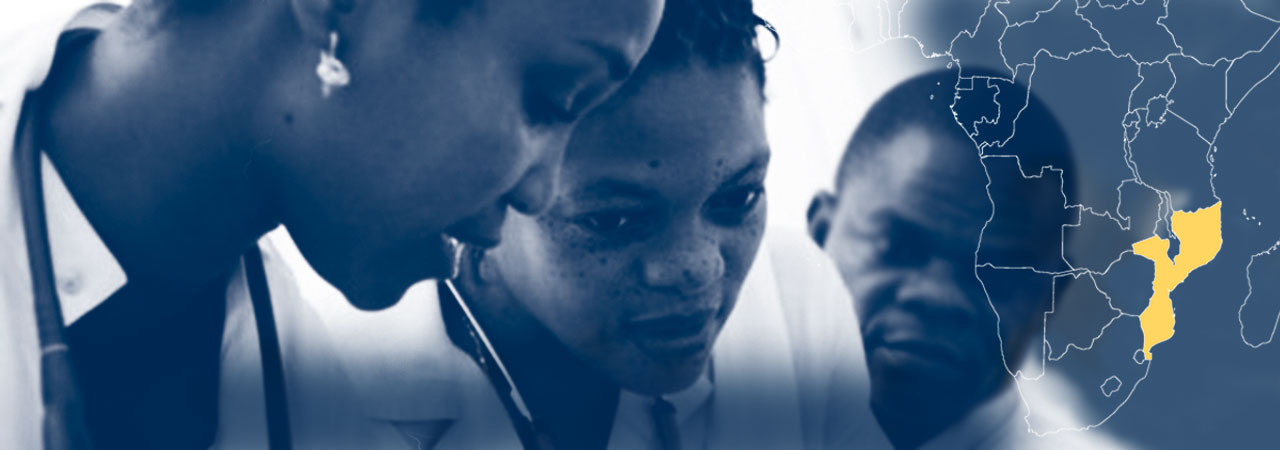
Mozambique
Spotlight: Supporting Those Behind The Scenes of the HIV Epidemic
There is no doubt that teaching in any setting can be challenging. However, it can be even more so when your students are those who will be on the front line in the battle against AIDS. The teachers in the Ministry of Health's training institutes for técnicos de medicina (TDMs), the equivalent of physician assistants in the United States, have unique challenges. Not only must they prepare their students in 30 months without teaching materials or training in HIV content, but they must transform these students with a 10th grade high-school education into clinicians who can effectively diagnose and treat HIV with insufficient laboratory services and diagnostic equipment. These teachers are among those behind the scenes of the HIV epidemic, preparing young adults for a career which may prolong the lives of many Mozambicans.
In partnership with CDC and through financing by the US President's Emergency Plan for AIDS Relief (PEPFAR), I-TECH provides training to faculty of health worker training institutes who play a critical, yet often hidden, role in the country's health care system. Since 2006, I-TECH has been working with the Ministry of Health to reform the undergraduate training of the TDMs. The overall goal is to assist the Mozambican government in the national scale-up of its HIV and AIDS response, both in terms of graduating more TDMs who can provide treatment and in terms of ensuring that those who do graduate are prepared to offer quality care to their patients.
In 2007, I-TECH initiated a series of capacity-building interventions, including the development of a standardized undergraduate curriculum with a strong HIV component, the development of supportive clinical practice opportunities for students, management training for institute directors, training in interactive teaching methods for institute faculty, and the initiation of a long-term mentoring program for faculty. With these tools, Mozambique can look forward to more clinicians who can offer high-quality care to HIV-positive individuals.
Overview
I-TECH initiated its activities in Mozambique in December 2005 through an invitation from the US Centers for Disease Control and Prevention Global AIDS Program (CDC GAP), Mozambique. After a preliminary assessment and a series of technical assistance visits, I-TECH opened an office in February 2007 and continues to expand. I-TECH Mozambique's main objective is to build capacity within the Ministry of Health (MISAU) to address the shortage of personnel qualified to diagnose and treat individuals with HIV and AIDS. Central to this effort is the training and mentoring of health care workers, particularly técnicos de medicina (TDMs; similar to physician assistants) to provide quality HIV and AIDS care and treatment.
Program Highlights
Delivering Pre-service Training. At the invitation of the Mozambican Ministry of Health, I-TECH is providing expert technical assistance to its Training Unit and to seven of the 13 national Health Training Institutes in order to improve the quality of undergraduate education program for TDMs, who are increasingly responsible for the clinical treatment of HIV and AIDS.
Three major activities are under way: a team of clinicians is developing a six-week course on AIDS/TB/ opportunistic infections/malaria/malnutrition (ATOMM) to be integrated into the 30-month curriculum for TDMs; a curriculum developer assigned to MISAU's Training Unit is assisting in a review of the overall content of the TDM curriculum; and I-TECH trainers have designed a course in faculty development to improve the skills of Health Training Institute instructors in lesson planning and participatory learning methods, which will better prepare them for delivering the new ATOMM material.
Augmenting In-Service Training. I-TECH is developing/revising several in-service curricula related to HIV and AIDS. Working in conjunction with Columbia University's International Center for AIDS Care and Treatment Programs (ICAP), I-TECH designed a training of trainers (TOT) course for TDMs in antiretroviral therapy (ART, or "TARV" in Portuguese) and collaborated on the development of a course in ART adherence. I-TECH is currently revising other in-service curricula for mid-level practitioners, including refresher training on ART, opportunistic infections, and pediatric ART.
Ensuring Quality through Assessment and Evaluation. I-TECH has implemented several assessments of curricula and training programs, such as formative evaluations of didactic training courses and a laboratory mentoring pilot program; an inventory of HIV in-service curricula; and rapid assessments of pre-service and in-service training for TDMs. These last two activities led to a nationwide clinical evaluation of the HIV and AIDS diagnosis and treatment skills of TDMs who had attended the two-week ART course. The results of this evaluation will assist MISAU in improving the quality of care provided by TDMs and inform the content of future training and mentoring programs.
Promoting Clinical Mentoring. Two projects are under development, which combine didactic and hands-on training for health workers. I-TECH is collaborating with Columbia University to pilot a clinical mentoring program for government nurses who provide prevention of mother-to-child transmission (PMTCT) services. I-TECH is also assisting MISAU in the development of a clinical mentoring program to improve the clinical skills of TDMs who provide HIV care and treatment.
Strengthening PMTCT Support Groups. In 2008, I-TECH conducted a nationwide inventory and analysis of best practices among support groups aimed at promoting the prevention of mother-to-child transmission of HIV. Based on this inventory and analysis, which included 250 interviews with nurses, activists, and governmental, and non-governmental implementers, I-TECH will create a package of procedures, tools, and training materials to help support group leaders face the challenges of providing psychosocial support to thousands of HIV-infected pregnant women and new mothers.
